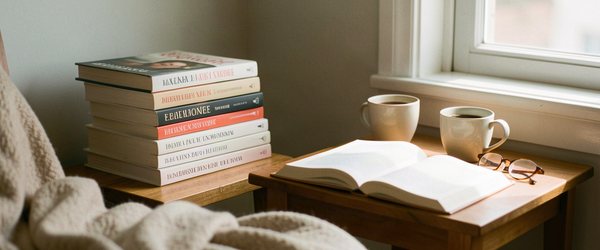
If you have finished a course or two and want to move past textbook dialogues, your first French novel is the natural next step. It also feels like a big one. Hundreds of pages, unfamiliar vocabulary, and no audio to lean on can make a paperback look more intimidating than it really is. The good news is that reading in French gets easier surprisingly fast once you start, and choosing the right first book makes all the difference. Here is how to pick one you can actually finish.
Why a novel beats a textbook
Novels do something a textbook never quite manages. They repeat the same everyday verbs and connectors over and over until they stick, but in a way that keeps your attention. You stop seeing je crois que or au bout de as grammar points and start hearing them the way a native speaker does. The payoff shows up quickly too. Learners who finish even one short book usually notice their reading speed jump within a few chapters, because the brain finally stops translating word by word and starts absorbing whole phrases. The real challenge is not the reading itself. It is choosing a book you can reach the last page of.
What to look for in a first book
Choose a short book, not a literary classic. A good first novel is under 200 pages, written in modern everyday French, and ideally a story you already know. A familiar plot frees up your brain to focus on the language instead of wondering what happens next. Four things matter most:
- Under 200 pages, so you can finish within a few weeks and feel the win.
- Modern, dialogue heavy writing rather than dense nineteenth century prose.
- A story you already know, or a thriller with a clear, fast moving plot.
- A translation of a book you have read in your own language, so context fills the gaps.
How to read it without a dictionary
Resist the urge to look up every word. Stopping for a dictionary after each sentence breaks the flow and makes the book feel endless. Aim to understand the gist of each paragraph instead. If a word shows up three times and still blocks you, look it up then and write it down. For everything else, guess from context and move on. You will be surprised how much you can follow even when individual words slip by, and the guessing itself is exactly the skill you want to build.
Titles that work for beginners
The most recommended starting points are recommended for a reason. Le Petit Nicolas by René Goscinny is a collection of short, funny school stories written for children but loved by adults, and the humour survives at an A2 level. L’Étranger by Albert Camus is famous for its short sentences and plain style, which makes it readable far earlier than its literary reputation suggests. For a modern thriller, Guillaume Musso writes fast, plot driven novels in clear contemporary French that plenty of learners finish as their first real book. And if you want a translation you already know, the French editions of Harry Potter are a classic choice because the vocabulary repeats so predictably from chapter to chapter.
Once you finish that first short novel, reading French news stops feeling like decoding. The connective tissue of the language, the il faut, the peut-être, the au moment où, has already settled in from your book. Headlines and leads get easier to scan, and the daily news feed becomes a natural follow up to the longer reading you now handle without panic. Start short, finish it, and the news will feel noticeably lighter the next morning.